In the name of God, Most Gracious, Most Merciful....
This Blog is a collaborative space containing global perspectives on Life,Religion & Culture.A collection of links, it is my own area of private thoughts.It also contains a little poetry.....
vow to thee, my country, all earthly things above, Entire and whole and perfect, the service of my love; The love that asks no questions, the love that stands the test, That lays upon the altar the dearest and the best; The love that never falters, the love that pays the price, The love that makes undaunted the final sacrifice.
And there's another country, I've heard of long ago, Most dear to them that love her, most great to them that know; We may not count her armies, we may not see her King; Her fortress is a faithful heart, her pride is suffering; And soul by soul and silently her shining bounds increase,[10] And her ways are ways of gentleness, and all her paths are peace
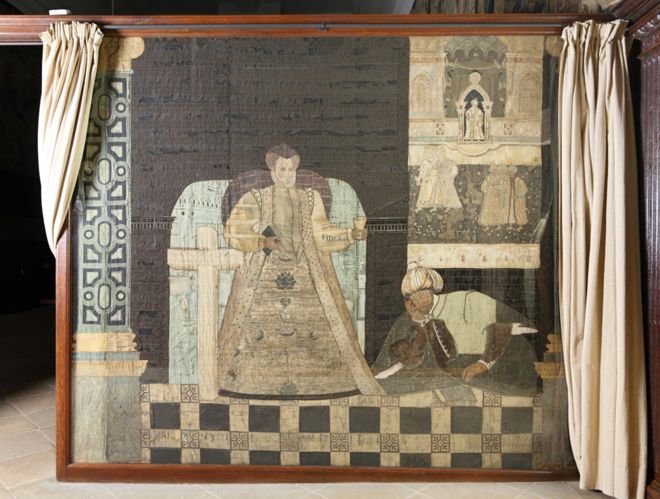
Image copyright Bridgeman ImagesImage caption "True Faith and Mahomet" a needlework hanging at Hardwick Hall in Derbyshire
From as far away as North Africa, the Middle East and Central Asia, Muslims from various walks of life found themselves in London in the 16th Century working as diplomats, merchants, translators, musicians, servants and even prostitutes.
The reason for the Muslim presence in England stemmed from Queen Elizabeth's isolation from Catholic Europe. Her official excommunication by Pope Pius V in 1570 allowed her to act outside the papal edicts forbidding Christian trade with Muslims and create commercial and political alliances with various Islamic states, including the Moroccan Sa'adian dynasty, the Ottoman Empire and the Shi'a Persian Empire.
She sent her diplomats and merchants into the Muslim world to exploit this theological loophole, and in return Muslims began arriving in London, variously described as "Moors", "Indians", "Negroes" and "Turks".
Before Elizabeth's reign, England - like the rest of Christendom - understood a garbled version of Islam mainly through the bloody and polarised experiences of the Crusades.
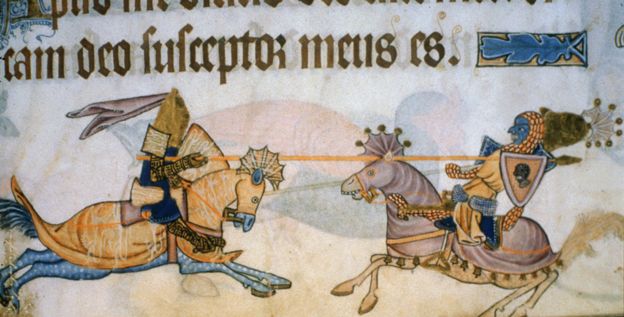
Image copyright AlamyImage caption The Medieval English view of Islam was viewed through the bloody experiences of the Crusades No Christian even knew the words "Islam" or "Muslim", which only entered the English language in the 17th Century. Instead they spoke of "Saracens", a name considered in medieval times to have been taken from one of Abraham's offspring (with the servant Hagar) who was believed to have founded the original twelve Arab tribes.
Christians simply could not accept that Islam was a coherent religious belief. Instead they dismissed it as a pagan polytheism or a heretical deformation of Christianity. Much Muslim theology discouraged travel into Christian lands, or the "House of War", which was regarded as a perpetual adversary of the "House of Islam".
But with Elizabeth's accession this situation began to change. In 1562 Elizabeth's merchants reached the Persian Shah Tahmasp's court where they learned about the theological distinctions between Sunni and Shi'a beliefs, and returned to London to present the queen with a young Muslim Tatar slave girl they named Aura Soltana.
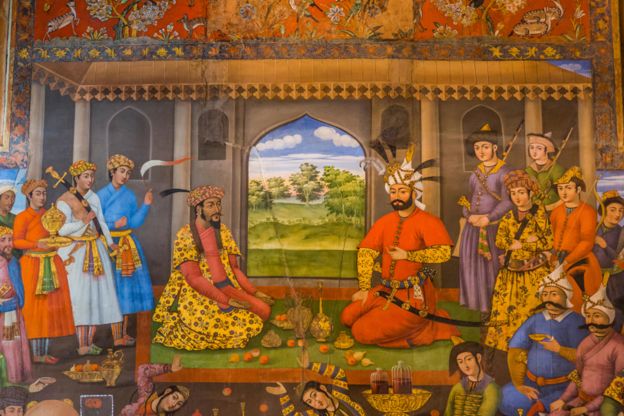
She became the queen's "dear and well beloved" servant who wore dresses made of Granada silk and introduced Elizabeth to the fashion of wearing Spanish leather shoes. Image copyright AlamyImage caption Painting showing the court of Shah Tahmasp receiving the Mughal emperorHundreds of others arrived from Islamic lands and although no known memoirs survive, glimpses of their Elizabethan lives can still be gleaned from London's parish registers. In 1586 Francis Drake returned to England from Colombia with a hundred Turks who had been captured by the Spanish in the Mediterranean and press-ganged into slavery in the Americas.
One of them, known only as Chinano, is the first known Muslim to convert to English Protestantism.
He was baptised at St Katharine's Church near the Tower of London, where he took the name William Hawkins, and insisted that "if there were not a God in England, there was none nowhere".
Perhaps he meant it and relished his new Anglican identity, or he knew what to say to his new English masters. Whatever the truth, like many of his fellow Turks he quickly disappeared into London's bustling life, taking with him his true religious beliefs.
How sincere Chinano's conversion was may never be known, but he was not alone, and others like him were clearly keen to make a living in diverse urban occupations.
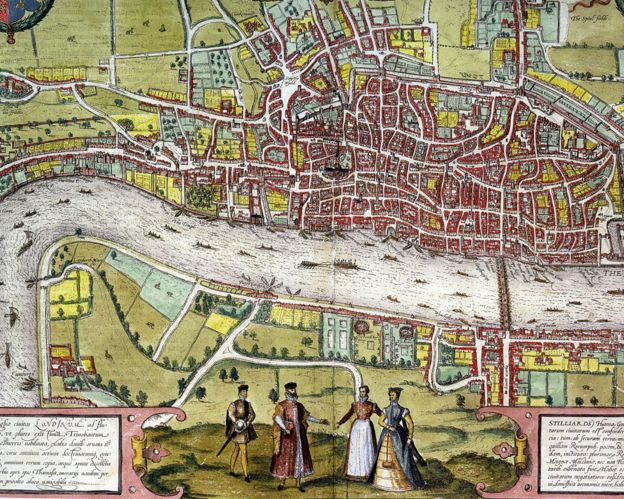
They included weavers, tailors, brewers and metalsmiths. Other registers record Muslim women being baptised like Mary Fillis, a "blackamoor" daughter of a Moroccan basket-maker who after working in London as a seamstress for 13 years and "now taking some hold of faith in Jesus Christ was desirous to become a Christian". Image copyright AlamyImage caption Elizabethan London - busy enough for foreigners to disappear into She was baptised in Whitechapel in 1597 where she presumably lived out the rest of her life. The faith of others was less certain, like the unnamed Moroccan who was buried the same year "without any company of people and without ceremony", because church authorities "did not know whether he was a Christian or not".
Nor were such conversions one-way. Hundreds of Elizabethan men and women travelled into Muslim lands in search of their fortune, and many converted - some forcibly, but others willingly - to Islam. They included the Norfolk merchant Samson Rowlie, who had been captured by Turkish pirates off Algiers in 1577, where he was imprisoned, castrated and converted to Islam.
He took the name Hassan Aga and rose to become Chief Eunuch and Treasurer of Algiers as well as one of the most trusted advisers to its Ottoman governor. He never returned to England or the Christian fold.
Elizabeth's alliances with the Ottoman, Persian and Moroccan empires also brought more elite Muslims to London. Records show that Turkish diplomats were sent over in the 1580s, though no trace of them survives.
More details remain of Moroccan embassies from later that decade. In 1589 the Moroccan ambassador Ahmed Bilqasim entered London in state, surrounded by Barbary Company merchants, proposing an Anglo-Moroccan military initiative against "the common enemy the King of Spain".
Although the anti-Spanish proposal came to nothing, the Moroccan ambassador sailed in an English fleet later that year that attacked Lisbon with the support of the Moroccan ruler, Mulay Ahmed al-Mansur.
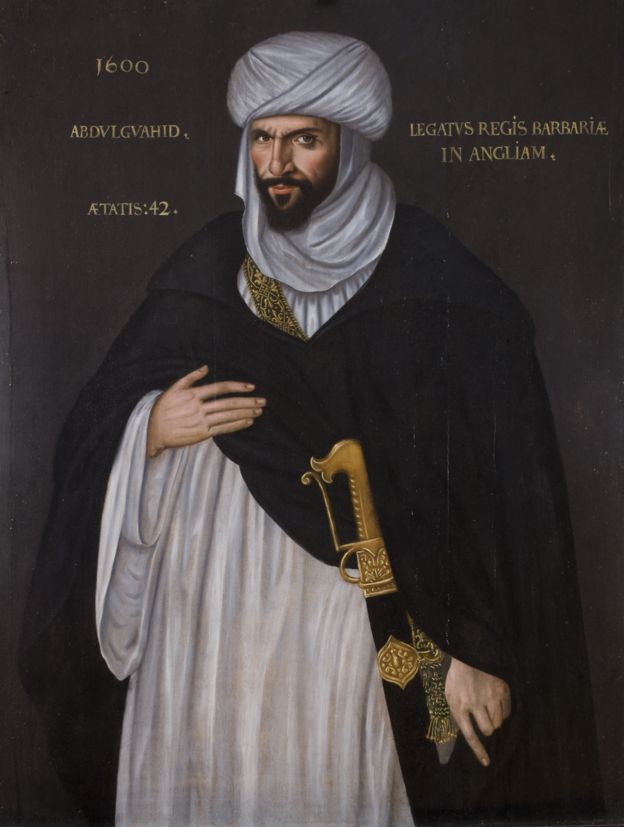
Just over 10 years later another Moroccan ambassador called Muhammad al-Annuri arrived in London, with a large retinue of merchants, translators, holy men and servants who stayed for six months living in a house on the Strand where Londoners watched them practising their religious faith. Image copyright University of BirminghamImage caption Muhammad al-Annuri, the Morrocan ambassador to England, 1600 One reported that they "killed all their own meat within their house, as sheep, lambs, poultry" and "turned their faces eastward when they kill any thing; they use beads, and pray to Saints".
Al-Annuri had his portrait painted, met Elizabeth and her advisers twice and even proposed a joint Protestant-Islamic invasion of Spain and naval attack on her American colonies. The plan only seems to have foundered because Elizabeth feared upsetting the Ottomans, who were at the time al-Mansur's adversaries.
The alliance came to an abrupt end with Elizabeth's death and her successor James I's decision to make peace with Catholic Spain, but the presence of Muslims like al-Annuri, Ahmed Bilqasim and more modest individuals like Chinano and Mary Fillis remain a significant but neglected aspect of Elizabethan history.
It shows that Muslims have been a part of Britain and its history much longer than many people have ever imagined.
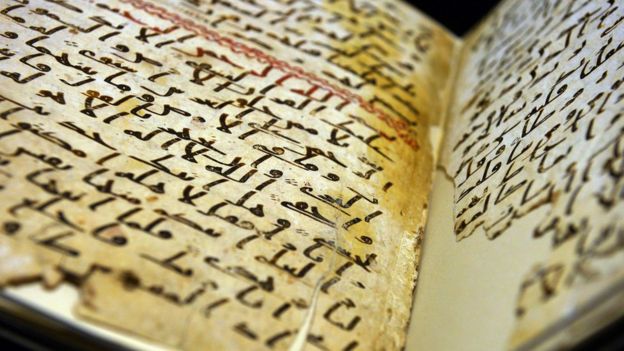
The Koran's long journey into British life
Image copyrightAFP
1095-1291 - The Crusades result in crusaders bringing some Middle Eastern customs and Arabic words back to England.
1588 - Christopher Marlowe's play Tamburlaine the Great contains a scene in which the Koran is burned.
1636 - Oxford University employs a chair of Arabic, who advocates a rational, historical approach to the study of Islam.
1734 - The first full translation of the Koran into English is made.
1869 - Lord Stanley becomes the first Muslim convert in the House of Lords.
1935 - Words from the Koran are broadcast on British radio for the first time, in BBC programme The Sphinx.
1997 - MP Muhammad Sarwar becomes the first person to swear his Oath of Allegiance on the Koran in the House of Commons.
Jerry Brotton is the author of This Orient Isle: Elizabethan England and the Islamic World
In London's historic "Inns of Court", barristers practise law in the shadow of the distinctive medieval Temple Church. But does English law really owe a debt to Muslim law?
One of the mainstays of English justice
For some scholars, a historical connection to Islam is a "missing link" that explains why English common law is so different from classical Roman legal systems that hold sway across much of the rest of Europe. It's a controversial idea. Common law has inspired legal systems across the world. What's more, calls for the UK to accommodate Islamic Sharia law have caused public outcry. The first port of call when looking for an eastern link in the common law is London's Inns of Court.
"You are now leaving London, and entering Jerusalem," says Robin Griffith-Jones, the Master of the Temple Church, as he walks around its spectacular rotunda. The church stands in the heart of the legal district and was built by the Knights Templar, the fierce order of monks-turned-warriors who fought Muslim armies in the Crusades. London's historic legal district, with its professional class of independent lawyers, has parallels with the way medieval Islamic law was organised. In Sunni Islam there were four great schools of legal theory, which were often housed in "madrassas" around mosques. Scholars debated each other on obscure points of law, in much the same way as English barristers do. There is a theory that the Templars modelled the Inns of Court on Muslim ideas. But Mr Griffith-Jones suggests it is pretty unlikely the Templars imported the madrassa system to England. They were suppressed after 1314 - yet lawyers only started congregating in the Inns of Court after the 1360s
Perpetual endowment This doesn't necessarily rule out the Templars' role altogether. Medieval Muslim centres of learning were governed under a special legal device called the "waqf" under which trustees guaranteed their independence. In an oak-panelled room in Oxford, historian Dr Paul Brand explains the significance of the 1264 statute that Walter De Merton used to establish Merton College. He was a businessman with connections to the Knights Templar.
The Templar link to Islamic law seems unlikely
The original 1264 document that established Merton has parallels with the waqf because it is a "perpetual endowment" - a system where trustees keep the college running through the ages. It's been used as a template across the Western world. Dr Brand says many branches of Western learning, from mathematics to philosophy, owe a debt of gratitude to Islamic influence. Advanced Arabic texts were translated into European languages in the Middle Ages. But there's no record of Islamic legal texts being among those influencing English lawyers. And Dr Brand pointed out the Knights Templar were, after all, crusaders. They wanted to fight Muslims, not to learn from them, and they were rarely close enough to observe their institutions at work. But the fact remains that England in the Middle Ages had very distinct legal principles, like jury trial and the notion that "possession is nine tenths of the law". And there was one other place in Europe that had similar legal principles on the books in the 12th Century. Jury trial From the end of the 9th to the middle of the 11th Century, Sicily had Muslim rulers. Many Sicilians were Muslims and followed the Maliki school of legal thought in Sunni Islam. Maliki law has certain provisions which resemble English legal principles, such as jury trial and land possession. Sicily represented a gateway into western Europe for Islamic ideas but it's unclear how these ideas are meant to have travelled to England. Norman barons first invaded Sicily in 1061 - five years before William the Conqueror invaded England. The Norman leaders in Sicily went on to develop close cultural affinities with the Arabs, and these Normans were blood relations of Henry II, the English king credited with founding the common law. But does that mean medieval England somehow adopted Muslim legal ideas?
Merton College was founded on principles similar to Islamic law
There is no definitive proof, because very few documents survive from the period. All we have is the stories of people like Thomas Brown - an Englishman who was part of the Sicilian government, where he was known in Arabic as "Qaid Brun". He later returned to England and worked for the king during the period when common law came into being. There is proof he brought Islamic knowledge back to England, especially in mathematics. But no particular proof he brought legal concepts. There are clear parallels between Islamic legal history and English law, but unless new historical evidence comes to light, the link remains unproven.
Do not stand at my grave and weep I am not there. I do not sleep. I am a thousand winds that blow. I am the diamond glints on snow. I am the sunlight on ripened grain. I am the gentle autumn rain. When you awaken in the morning's hush I am the swift uplifting rush Of quiet birds in circled flight. I am the soft stars that shine at night. Do not stand at my grave and cry; I am not there. I did not die.