Monday, 2 February 2026

The Reality

The REALITY


Everyday he fails to eat

his limbs have become weak

he thinks of his old life, and what it use to be,

how he use to find all the delicious food to eat

he is lying there in the shining sun,

some part of him is longing for his death to come

not knowing of what he will soon become,

he knows inside that death is certainly near

he thinks to him self that he is to young, 

but then he sees it steadily approaching closer and closer

now it is here, he is in pain and fear

Its on top of him now,  

its starts from his toes and gradually works its way to his feet,

moving quickly to his knees, 

till it is upon his side

he feels his body going cold, 

now he is in fear

what has his life become ? 

After the proxy war has gone !

Tuesday, 22 December 2020

Why I became Muslim - Jacob Williams

Growing up in twenty-first-century Britain, I was often struck by a feeling of anomie. Around the time I was born, John Major tried to evoke a vanished past by conjuring “long shadows on county grounds” and “old maids bicycling to Holy Communion through the morning mist.” As for my generation, it had only the faintest notion of our once-great national religion. The Anglican Church had become a shadow of itself, reduced to the picturesque, empty buildings that adorned our lanes and streets. It was a shadow we noticed when we shuffled into the parish church’s cold, echoing interior for the Harvest Festival and sang the cheery modern hymns that church bureaucrats imagined we would like.

Anomie was one thing; the ferocious renunciation of tradition I encountered at university was quite another. I had hoped that the spiritual emptiness of wider society was a result of ignorance, and that the ­academy—especially the ancient, venerable, Gothic academy of Oxford—had preserved what I vaguely imagined was my country’s noble heritage. Studying philosophy did provide some engagement with an intellectual inheritance, but for anyone moderately interested in public life, the campus movements for “social justice” were impossible to ignore. All of these—whether their goal was the liberation of women, of LGBT persons, or of ethnic minorities—seemed to have the same vision of man: a deracinated, protean aggregate of desires. These movements gained in strength every year. ­Formerly apolitical spaces were distorted by the need to appease one demand after another. The culture of the university, once imbued with the brash boyishness of the English public schools, now accommodated the sterile, strenuous inclusivity of progressive zealots.

After three years of this, I was frustrated and alienated. I needed a purpose. Philosophy classes had sharpened my inquiries, but they didn’t rectify the meaninglessness all around me. My utopian peers found their purpose in crusades against racism and homophobia, but their contempt for England revolted me. I chose a different course and embarked on a search for God.

Where could a lost soul go? Nowhere in college or country offered an answer. What the campus Conservative Party outlined was absurd: We can pick up the fragments of our culture by putting on three-piece suits, getting riotously drunk, and reviving the divine right of kings. I had plenty of opportunities to engage with orthodox Christians, and I sincerely wanted Christianity to be true. It was clear to me that what the authorities in my world celebrated—the collapse of family life, the slaughter of the unborn, the deterioration of high culture—were, in truth, social evils that followed from the decline of the Church. Christianity seemed the natural alternative to secularity.

But when I entered the chapels and listened to the ministers, the regeneration I sought didn’t happen. Christian voices sounded all too agreeable and compromising. I wanted something stronger, something that didn’t ­bargain with secularism. I found it in Islam.

The first part of the Islamic ­shahada, or testimony of faith, is la ilaha il’Allah, “there is no god but God”—an uncompromising statement of pure mono­theism. Islam puts the One God front and center, a simple and commanding being. Philosophy had persuaded me that God was an intellectual and moral necessity. I did not know whether his existence could strictly be proven, but I recognized the dishonesty and intellectual contortions atheism required. Without an absolute, transcendent Lord, I could see no way to objective morality and to a purpose and order in the cosmos that could overcome the transience of this world. I doubted that we could justify even belief in causal regularities without a constantly acting Creator to guarantee them. If I were to embrace God, then God would need to be an ­unmediated, undifferentiated, and decisive Omnipotence, whom I might ­willingly obey.

My problem with Christianity arose from the contrast between the abstract Divinity who answers such questions and the all-too-human majesty of Jesus (peace be upon him). Surely God, if he was God, had to be a perfectly simple being, absolutely distinct from his creation. If his separation was questioned, then he wasn’t really the infinite Creator I sought. How could this transcendent being be identical with the fleshy Messiah portrayed in church, complete with his bloody stigmata? The mystery of the Trinity seemed to me a dark glass that made God’s majesty dimmer, not brighter. Rather than puzzling indefinitely, I sided with simplicity and affirmed the Islamic doctrine of tawhid: God’s absolute oneness.

So goes the first shahada. The second declares Muhammadun rasool’Allah: “Muhammad is the Messenger of God.” This is a matter of Scripture. In the Qur’an’s claims to be the direct speech of God, Islam again seemed a simpler and more compelling story. One God, one final Message.

C. S. Lewis argued that a man claiming to be God must be either a lunatic, a liar, or truly the Lord. Likewise, a man claiming to be a Messenger of God must be either insane, dishonest, or just what he says he is. I judged, based on my reading of history, that Muhammad (peace be upon him) could not have been either of the former two. The facts of his life and ministry reveal an honest man in full possession of his rational faculties. By contrast, it wasn’t hard for me to avoid Lewis’s trilemma, because Muslims simply do not believe that Jesus (peace be upon him) ever claimed to be God. Rather, we hold him to have been another prophet like Moses, Abraham, and Isaac (peace be upon them all). The final piece of the puzzle fell into place upon my learning of the long process of redaction and recomposition that produced the canon that became the Bible. This was consistent with the Islamic narrative of an earlier revelation that, though true, was imperfectly preserved. The Qur’an was the unification and confirmation of what the Bible merely tried to assemble.

All reasoning is motivated by something—and perhaps, under different circumstances, I might have reached different conclusions. But what started my search for God was my inability to feel at home in the England of the 2010s. The country in which I was born, raised, and schooled had imparted the sense of Islam as wholly foreign, strange, and backward, the antithesis of our entire civilization. And as a historical matter, I had learned, the West emerged in part through its self-definition over against Islam. This, then, was the hardest part: opening my heart to the truth of Islam and ceasing to see it as another destabilizing force, alien to the tradition I loved.

What was happening around me made it easier, however. At one point, a campaign was launched at my university called, “Why is my curriculum white?” The premise was that a British university should not teach British authors because doing so might make cultural minorities feel unwelcome. In other words, “Orientalism,” which cast the East as Other, had to stop. On hearing of this campaign, I recognized that the only way to create a world with no “others” is to have no self. While my Christian conservative friends objected to this denigration of the West, I saw the deeper aim, which was to eliminate the self, to deny all of us a home, a country, and indeed a religion. I had absorbed enough of the remnants of what Charles Taylor calls the British synthesis—the conflation of Britishness, Christianity, liberty, and sexual restraint—to experience such losses as catastrophic. My journey toward Islam thus began not with a rejection of the Western tradition and inheritance but with a strong desire to affirm as much of it as might prove compatible with religious truth. Faith, I hoped, could be reconciled with the secondary loves of my family and flag.

Of course, Islam, like all universalist religions, abhors narrow, jingoistic nationalism and ethnocentrism. But it respects the deeper patriotic impulse that originates in love of one’s home. This point was made clear to me by Roger Scruton’s England: An Elegy. English culture and institutions, Scruton argues, were founded on a deep connection with geographical particularity and manifested in forms such as the horizontal idiom of English church architecture, which affirms an enchantment in the land rather than gesturing dizzyingly (and futilely) upward. Islam, I was happy to discover, values this type of organic connection to place while treating patriotic attachment to the nation-state as a flawed loyalty. The Qur’an rejects nationalistic chauvinism while nonetheless recognizing that mankind is divided into “nations and tribes” for which we naturally have affection.

So, I began to see that Islam was able to appreciate the West’s good qualities. As I studied further, I saw the possibility of beneficial exchange between these historically opposed cultures. I learned how much Islamic civilization owes to Greek philosophy, Roman statecraft, and now the Industrial Revolution. By coming to see Islam as a means of stability and regeneration, I overcame the difficulty of adopting a religion other than that of my fathers. My peers and teachers were busy desecrating the Western tradition. Islam stood a chance of preserving it.

By this time, Islam felt more familiar to me than did the Christianity of my home. Tepid, half-believing Anglicanism—“almost-instinct almost true,” in Philip Larkin’s words—couldn’t stop the spread of utopian progressivism on campus or London’s arid diversity. I needed a different antidote for the hedonism of my culture. By the time I went to North Africa to witness Islam as a lived reality, my ­anxieties had dissolved. I was soon able to enter the state of islam, or “submission to God,” without ceasing to be the person I had been. I did not change my name, my style of dress, or my diet (save that I now take halal beef with my eggs rather than bacon). I enjoy the Anglo-Muslim poetry and music produced by my coreligionists over the last century and a half. I am still moved by the landscapes of Constable and I still feel that Shakespeare offers among the deepest insights of any writer into the vicissitudes of the human soul. Above all, the vapid global consumer monoculture dissipates when I undergo submission to the One True God. I appreciate the best of the West, not despite being a Muslim, but because of it.

I experience being Muslim and being British not as tension, but as convergence. As the Islamic scholar Umar Faruq Abd-Allah puts it, Islam is the clear water of pure mono­theism, colored by the bedrock of the native soil over which it flows. Life as a Muslim in the West does not consign you to being a diasporic Arab or Desi; it need not produce awkward and anxious suspension between two civilizations. Another scholar, Timothy Winter, sums up my feelings eloquently: “[Islam] is generous and inclusive. It allows us to celebrate our particularity, the genius of our heritage; within, rather than in tension with, the greater and more lasting fellowship of faith.” It is my ardent hope that the cause of God and truth will be served when others, too, come to see this.

Jacob Williams is a writer living in London, England.

https://www.firstthings.com/article/2019/05/why-i-became-muslim

Monday, 6 April 2020

Poem Stopping by Woods on a Snowy Evening :Robert Frost

Whose woods these are I think I know.   
His house is in the village though;   
He will not see me stopping here   
To watch his woods fill up with snow.   

My little horse must think it queer   
To stop without a farmhouse near   
Between the woods and frozen lake   
The darkest evening of the year.   

He gives his harness bells a shake   
To ask if there is some mistake.   
The only other sound’s the sweep   
Of easy wind and downy flake.   

The woods are lovely, dark and deep,   
But I have promises to keep,   
And miles to go before I sleep,   
And miles to go before I sleep.

Poem : I Vow to Thee, My Country By Sir Cecil Spring Rice

 vow to thee, my country, all earthly things above,
Entire and whole and perfect, the service of my love;
The love that asks no questions, the love that stands the test,
That lays upon the altar the dearest and the best;
The love that never falters, the love that pays the price,
The love that makes undaunted the final sacrifice.

And there's another country, I've heard of long ago,
Most dear to them that love her, most great to them that know;
We may not count her armies, we may not see her King;
Her fortress is a faithful heart, her pride is suffering;
And soul by soul and silently her shining bounds increase,[10]
And her ways are ways of gentleness, and all her paths are peace

Tuesday, 18 February 2020

The first Muslims in England

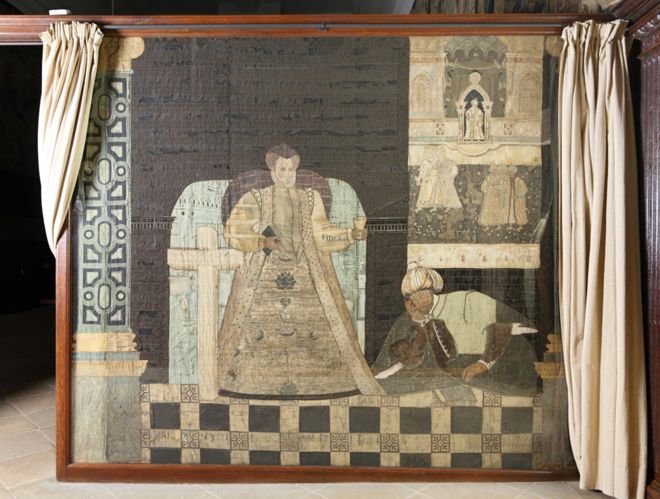
True Faith and Mahomet (silk), English School, (16th century) / Hardwick Hall, Derbyshire, UK
Image copyright Bridgeman ImagesImage caption "True Faith and Mahomet" a needlework hanging at Hardwick Hall in Derbyshire
From as far away as North Africa, the Middle East and Central Asia, Muslims from various walks of life found themselves in London in the 16th Century working as diplomats, merchants, translators, musicians, servants and even prostitutes.
The reason for the Muslim presence in England stemmed from Queen Elizabeth's isolation from Catholic Europe. Her official excommunication by Pope Pius V in 1570 allowed her to act outside the papal edicts forbidding Christian trade with Muslims and create commercial and political alliances with various Islamic states, including the Moroccan Sa'adian dynasty, the Ottoman Empire and the Shi'a Persian Empire.
She sent her diplomats and merchants into the Muslim world to exploit this theological loophole, and in return Muslims began arriving in London, variously described as "Moors", "Indians", "Negroes" and "Turks".
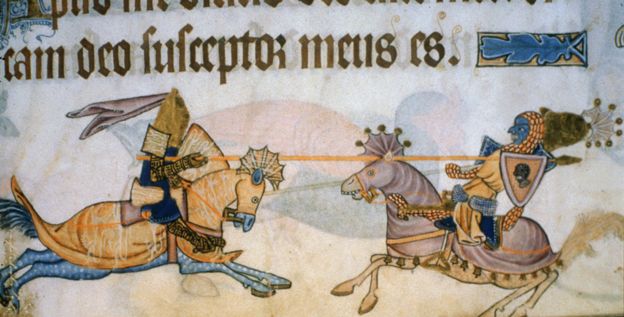
Before Elizabeth's reign, England - like the rest of Christendom - understood a garbled version of Islam mainly through the bloody and polarised experiences of the Crusades.
King RICHARD I of England, the Lionheart, 1157-99, fighting Saladin, 1138-93, Ayyubid ruler of Egypt and Syria
 Image copyright Alamy
Image caption The Medieval English view of Islam was viewed through the bloody experiences of the Crusades
No Christian even knew the words "Islam" or "Muslim", which only entered the English language in the 17th Century. Instead they spoke of "Saracens", a name considered in medieval times to have been taken from one of Abraham's offspring (with the servant Hagar) who was believed to have founded the original twelve Arab tribes.
Christians simply could not accept that Islam was a coherent religious belief. Instead they dismissed it as a pagan polytheism or a heretical deformation of Christianity. Much Muslim theology discouraged travel into Christian lands, or the "House of War", which was regarded as a perpetual adversary of the "House of Islam".
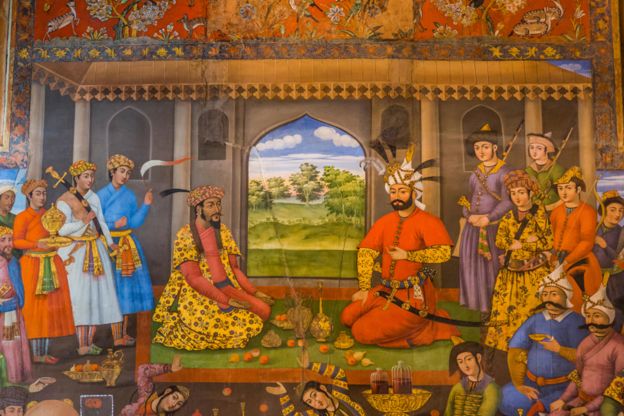
But with Elizabeth's accession this situation began to change. In 1562 Elizabeth's merchants reached the Persian Shah Tahmasp's court where they learned about the theological distinctions between Sunni and Shi'a beliefs, and returned to London to present the queen with a young Muslim Tatar slave girl they named Aura Soltana.
She became the queen's "dear and well beloved" servant who wore dresses made of Granada silk and introduced Elizabeth to the fashion of wearing Spanish leather shoes.
Detail of painting of Shah Tahmasp and the Mughal emperor Humayun, Chehel Sutun Palace, Isfahan, Iran 
Image copyright Alamy
Image caption Painting showing the court of Shah Tahmasp receiving the Mughal emperor
Hundreds of others arrived from Islamic lands and although no known memoirs survive, glimpses of their Elizabethan lives can still be gleaned from London's parish registers. In 1586 Francis Drake returned to England from Colombia with a hundred Turks who had been captured by the Spanish in the Mediterranean and press-ganged into slavery in the Americas.
One of them, known only as Chinano, is the first known Muslim to convert to English Protestantism.
He was baptised at St Katharine's Church near the Tower of London, where he took the name William Hawkins, and insisted that "if there were not a God in England, there was none nowhere".
Perhaps he meant it and relished his new Anglican identity, or he knew what to say to his new English masters. Whatever the truth, like many of his fellow Turks he quickly disappeared into London's bustling life, taking with him his true religious beliefs.
How sincere Chinano's conversion was may never be known, but he was not alone, and others like him were clearly keen to make a living in diverse urban occupations.
They included weavers, tailors, brewers and metalsmiths. Other registers record Muslim women being baptised like Mary Fillis, a "blackamoor" daughter of a Moroccan basket-maker who after working in London as a seamstress for 13 years and "now taking some hold of faith in Jesus Christ was desirous to become a Christian".
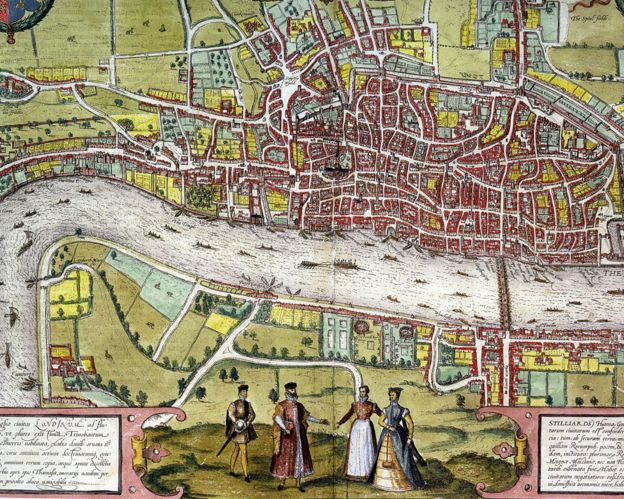
A map of Elizabethan London 
Image copyright Alamy
Image caption Elizabethan London - busy enough for foreigners to disappear into
She was baptised in Whitechapel in 1597 where she presumably lived out the rest of her life. The faith of others was less certain, like the unnamed Moroccan who was buried the same year "without any company of people and without ceremony", because church authorities "did not know whether he was a Christian or not".
Nor were such conversions one-way. Hundreds of Elizabethan men and women travelled into Muslim lands in search of their fortune, and many converted - some forcibly, but others willingly - to Islam. They included the Norfolk merchant Samson Rowlie, who had been captured by Turkish pirates off Algiers in 1577, where he was imprisoned, castrated and converted to Islam.
He took the name Hassan Aga and rose to become Chief Eunuch and Treasurer of Algiers as well as one of the most trusted advisers to its Ottoman governor. He never returned to England or the Christian fold.
Elizabeth's alliances with the Ottoman, Persian and Moroccan empires also brought more elite Muslims to London. Records show that Turkish diplomats were sent over in the 1580s, though no trace of them survives.
More details remain of Moroccan embassies from later that decade. In 1589 the Moroccan ambassador Ahmed Bilqasim entered London in state, surrounded by Barbary Company merchants, proposing an Anglo-Moroccan military initiative against "the common enemy the King of Spain".
Although the anti-Spanish proposal came to nothing, the Moroccan ambassador sailed in an English fleet later that year that attacked Lisbon with the support of the Moroccan ruler, Mulay Ahmed al-Mansur.
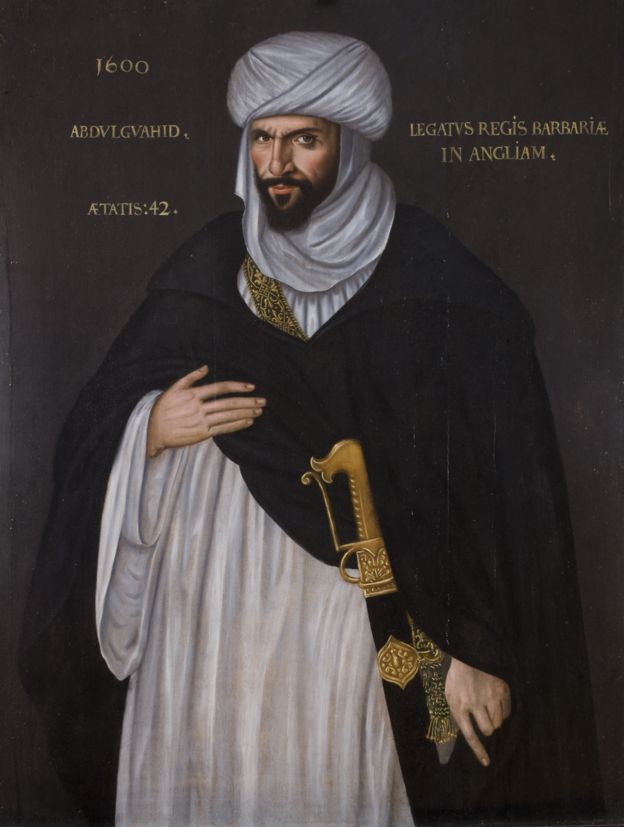
Just over 10 years later another Moroccan ambassador called Muhammad al-Annuri arrived in London, with a large retinue of merchants, translators, holy men and servants who stayed for six months living in a house on the Strand where Londoners watched them practising their religious faith.
Abd el-Ouahed ben Messaoud ben Mohammed Anoun, Moorish Ambassador to Queen Elizabeth I, 1600, oil on panel
 Image copyright University of Birmingham
Image caption Muhammad al-Annuri, the Morrocan ambassador to England, 1600
One reported that they "killed all their own meat within their house, as sheep, lambs, poultry" and "turned their faces eastward when they kill any thing; they use beads, and pray to Saints".
Al-Annuri had his portrait painted, met Elizabeth and her advisers twice and even proposed a joint Protestant-Islamic invasion of Spain and naval attack on her American colonies. The plan only seems to have foundered because Elizabeth feared upsetting the Ottomans, who were at the time al-Mansur's adversaries.
The alliance came to an abrupt end with Elizabeth's death and her successor James I's decision to make peace with Catholic Spain, but the presence of Muslims like al-Annuri, Ahmed Bilqasim and more modest individuals like Chinano and Mary Fillis remain a significant but neglected aspect of Elizabethan history.
It shows that Muslims have been a part of Britain and its history much longer than many people have ever imagined.

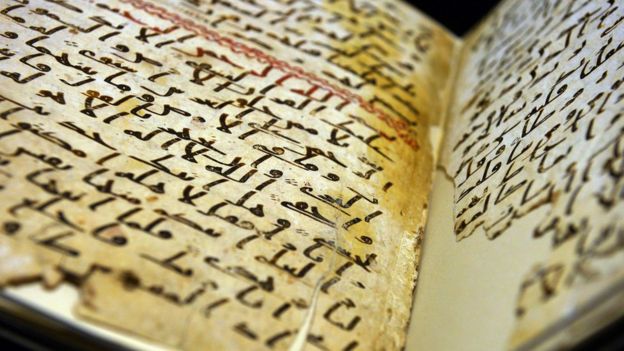
The Koran's long journey into British life

Quran manuscript found by the University of Birmingham 
Image copyrightAFP

  • 1095-1291 - The Crusades result in crusaders bringing some Middle Eastern customs and Arabic words back to England.
  • 1588 - Christopher Marlowe's play Tamburlaine the Great contains a scene in which the Koran is burned.
  • 1636 - Oxford University employs a chair of Arabic, who advocates a rational, historical approach to the study of Islam.
  • 1734 - The first full translation of the Koran into English is made.
  • 1869 - Lord Stanley becomes the first Muslim convert in the House of Lords.
  • 1935 - Words from the Koran are broadcast on British radio for the first time, in BBC programme The Sphinx.
  • 1997 - MP Muhammad Sarwar becomes the first person to swear his Oath of Allegiance on the Koran in the House of Commons.


Jerry Brotton is the author of This Orient Isle: Elizabethan England and the Islamic World

https://www.bbc.com/news/magazine-35843991


Sunday, 5 January 2020

Is English law related to Muslim law?

In London's historic "Inns of Court", barristers practise law in the shadow of the distinctive medieval Temple Church. But does English law really owe a debt to Muslim law?   


Old Bailey
One of the mainstays of English justice
 For some scholars, a historical connection to Islam is a "missing link" that explains why English common law is so different from classical Roman legal systems that hold sway across much of the rest of Europe. It's a controversial idea. Common law has inspired legal systems across the world. What's more, calls for the UK to accommodate Islamic Sharia law have caused public outcry. The first port of call when looking for an eastern link in the common law is London's Inns of Court.
"You are now leaving London, and entering Jerusalem," says Robin Griffith-Jones, the Master of the Temple Church, as he walks around its spectacular rotunda. The church stands in the heart of the legal district and was built by the Knights Templar, the fierce order of monks-turned-warriors who fought Muslim armies in the Crusades. London's historic legal district, with its professional class of independent lawyers, has parallels with the way medieval Islamic law was organised. In Sunni Islam there were four great schools of legal theory, which were often housed in "madrassas" around mosques. Scholars debated each other on obscure points of law, in much the same way as English barristers do. There is a theory that the Templars modelled the Inns of Court on Muslim ideas. But Mr Griffith-Jones suggests it is pretty unlikely the Templars imported the madrassa system to England. They were suppressed after 1314 - yet lawyers only started congregating in the Inns of Court after the 1360s

Perpetual endowment  This doesn't necessarily rule out the Templars' role altogether. Medieval Muslim centres of learning were governed under a special legal device called the "waqf" under which trustees guaranteed their independence. In an oak-panelled room in Oxford, historian Dr Paul Brand explains the significance of the 1264 statute that Walter De Merton used to establish Merton College. He was a businessman with connections to the Knights Templar.
Graves in Temple Church
The Templar link to Islamic law seems unlikely

The original 1264 document that established Merton has parallels with the waqf because it is a "perpetual endowment" - a system where trustees keep the college running through the ages. It's been used as a template across the Western world. Dr Brand says many branches of Western learning, from mathematics to philosophy, owe a debt of gratitude to Islamic influence. Advanced Arabic texts were translated into European languages in the Middle Ages. But there's no record of Islamic legal texts being among those influencing English lawyers. And Dr Brand pointed out the Knights Templar were, after all, crusaders. They wanted to fight Muslims, not to learn from them, and they were rarely close enough to observe their institutions at work. But the fact remains that England in the Middle Ages had very distinct legal principles, like jury trial and the notion that "possession is nine tenths of the law". And there was one other place in Europe that had similar legal principles on the books in the 12th Century.  Jury trial  From the end of the 9th to the middle of the 11th Century, Sicily had Muslim rulers. Many Sicilians were Muslims and followed the Maliki school of legal thought in Sunni Islam. Maliki law has certain provisions which resemble English legal principles, such as jury trial and land possession. Sicily represented a gateway into western Europe for Islamic ideas but it's unclear how these ideas are meant to have travelled to England. Norman barons first invaded Sicily in 1061 - five years before William the Conqueror invaded England. The Norman leaders in Sicily went on to develop close cultural affinities with the Arabs, and these Normans were blood relations of Henry II, the English king credited with founding the common law. But does that mean medieval England somehow adopted Muslim legal ideas?
Merton College
Merton College was founded on principles similar to Islamic law

There is no definitive proof, because very few documents survive from the period. All we have is the stories of people like Thomas Brown - an Englishman who was part of the Sicilian government, where he was known in Arabic as "Qaid Brun". He later returned to England and worked for the king during the period when common law came into being. There is proof he brought Islamic knowledge back to England, especially in mathematics. But no particular proof he brought legal concepts. There are clear parallels between Islamic legal history and English law, but unless new historical evidence comes to light, the link remains unproven.

By Mukul Devichand

http://news.bbc.co.uk/2/hi/uk_news/magazine/7631388.stm

Sunday, 22 December 2019

Invictus by Willaim Ernest Henley

Out of the night that covers me,
      Black as the pit from pole to pole,
I thank whatever gods may be
      For my unconquerable soul.

In the fell clutch of circumstance
      I have not winced nor cried aloud.
Under the bludgeonings of chance
      My head is bloody, but unbowed.

Beyond this place of wrath and tears
      Looms but the Horror of the shade,
And yet the menace of the years
      Finds and shall find me unafraid.

It matters not how strait the gate,
      How charged with punishments the scroll,
I am the master of my fate,
      I am the captain of my soul.

If by Rudyard Kipling

If you can keep your head when all about you   
    Are losing theirs and blaming it on you,   
If you can trust yourself when all men doubt you,
    But make allowance for their doubting too;   
If you can wait and not be tired by waiting,
    Or being lied about, don’t deal in lies,
Or being hated, don’t give way to hating,
    And yet don’t look too good, nor talk too wise:

If you can dream—and not make dreams your master;   
    If you can think—and not make thoughts your aim;   
If you can meet with Triumph and Disaster
    And treat those two impostors just the same;   
If you can bear to hear the truth you’ve spoken
    Twisted by knaves to make a trap for fools,
Or watch the things you gave your life to, broken,
    And stoop and build ’em up with worn-out tools:

If you can make one heap of all your winnings
    And risk it on one turn of pitch-and-toss,
And lose, and start again at your beginnings
    And never breathe a word about your loss;
If you can force your heart and nerve and sinew
    To serve your turn long after they are gone,   
And so hold on when there is nothing in you
    Except the Will which says to them: ‘Hold on!’

If you can talk with crowds and keep your virtue,   
    Or walk with Kings—nor lose the common touch,
If neither foes nor loving friends can hurt you,
    If all men count with you, but none too much;
If you can fill the unforgiving minute
    With sixty seconds’ worth of distance run,   
Yours is the Earth and everything that’s in it,   
    And—which is more—you’ll be a Man, my son!

Do Not Stand at My Grave and Weep

Do not stand at my grave and weep
I am not there. I do not sleep.
I am a thousand winds that blow.
I am the diamond glints on snow.
I am the sunlight on ripened grain.
I am the gentle autumn rain.
When you awaken in the morning's hush
I am the swift uplifting rush
Of quiet birds in circled flight.
I am the soft stars that shine at night.
Do not stand at my grave and cry;
I am not there. I did not die.

Mary Elizabeth Frye

Monday, 28 December 2015

A draft list of books recommended by Shaykh Ibrahim Osi-Efa

A draft list of books recommended by Shaykh Ibrahim Osi-Efa, collected by his students. The list is in no particular order.
  1. In the Absence of the Sacred – Jerry Mander
  2. Deep Nutrition – Catherine Shanahan
  3. On Disciplining the Soul – Al-Ghazali
  4. Breaking the Two Desires – Al-Ghazali
  5. Words and Rules – Steven Pinker
  6. Outliers – Malcolm Gladwell
  7. The Tipping Point – Malcolm Gladwell
  8. Milestones – Syed Qutb
  9. The Islamic Struggle in Syria – Dr Umar Faruq Abdullah
  10. Sea Without Shore – Shaykh Nuh Keller
  11. The Art Of Memory – Frances Yates
  12. Confessions of an Economic Hit Man – John Perkins
  13. Reflections – Shaykh Gai Charles Eaton
  14. The Value of Time – Shaykh Abd al-Fattah Abu Ghuddah
  15. Autobiography of Malcolm X – Malcolm X
  16. Mastery – Roberte Greene
  17. Brainsex: The real difference between men and women – Anne Moir & David Jessel
  18. Bury My Heart at Wounded Knee – Dee Brown
  19. Orality and literacy – Walter J Ong
  20. How to make Friends and Influence People – Dale Carnegie
  21. In praise of slow by Carl Honore Emotional Intelligence – Daniel Goleman
  22. Blink – Malcolm Gladwell
  23. Don’t think of an Elephant – George Lakoff
  24. Dumbing us down: The hidden curriculum of complusory schooling – John Taylor Gatto
  25. Unschooled Mind – Howard Gardner
  26. Ghosts in our blood – Jan Carew
  27. God and the new Physics – Paul Davies
  28. Hidden Messages in water – Masaru Emoto
  29. The Book of five rings – Miyamoto Musashi
  30. The Shallows: How the internet is changing the way we think, read and remember – Nicholas Carr,
  31. Mastery -George Leonard
  32. What the dog saw and other adventures – Malcolm Gladwell
  33. Who moved the stone? – Frank Morison
  34. Islam and the destiny of Man – Charles Le Gai Eaton
  35. Our Master Muhammad, The messenger of Allah – Imam ‘Abdallah Sirajuddin al-Husayni
  36. Evolution’s End: Claiming the potential of our intellgence
  37. The holographic universe – Michael Talbot
  38. How to create a mind – Ray Kurzweil
  39. The accident universe: The world you thought you knew – Alan Lightman
  40. Exploring the crack in the cosmic egg: split minds and meta-realities – Joseph Chilton Pearce
  41. Darwin’s Black box – Michael J. Behe

Monday, 8 June 2015

The Story of Shaykh Hamza Yusuf’s Conversion to Islam By Michael Sugich -


“The last time I saw him was in Los Angeles immediately after Anwar Sadat’s historic trip to Israel, which had endeared the Egyptian leader to the West and branded him a traitor to the Arab and Islamic world. Shaykh Al-Azhar [Dr. Abdul Halim Mahmoud, 1973-1978] had been sent by Sadat to the US on an official visit to reach out to the Muslim community in America. He gave a talk at UCLA, where we went to meet him. We were able to sit with the Shaykh for a while and then moved with his entourage to the Central Mosque in Los Angeles. He led the prayers. I was thrilled to stand shoulder to shoulder and pray beside the legendary qari (reciter of Qur’an) Shaykh Mahmoud Khalil Al-Houssari. Shaykh Al-Azhar then gave a press conference. I remember the reporter from Newsweek asked, tongue in cheek, “Do you think that America could become a Muslim country?” Shaykh Al-Azhar answered with a twinkle in his eye, “Why not? Americans believe in God and Islam is the religion of God. It is not impossible.” How things have changed.
Outside the mosque I met him. He greeted me warmly. I told him with some pride that three people had just converted to Islam with me. He smiled sweetly and said, “Why not three hundred?” His response left me defeated. Was he teaching me humility? Was he teaching me not to be satisfied with a small achievement but to aspire to greater things? I expected a pat on the back and felt that my efforts had been dismissed by this great man.
In retrospect, it occurred to me as I was setting down these memories decades later that one of the three souls who had converted to Islam was an intense and brilliant 18 year old former theological student who subsequently learned Arabic, traveled the world in search of knowledge, sitting with many of the great men of the Way and emerged as one of the most influential Muslim thinkers and orators in the West, reaching millions and guiding thousands on the path of Islam. He is known today as Shaykh Hamza Yusuf. In balance I would say he counts for three hundred, at the very least. Perhaps Shaykh Al-Azhar understood this with the eye of insight.
God knows best.”


(Michael Sugich, Signs on the Horizons)
http://www.amazon.co.uk/Signs-Horizons-Meetings-Knowledge-Illumination/dp/0989364011
-
 See more at: http://www.allahcentric.com/2014/09/01/the-story-of-shaykh-hamza-yusufs-conversion-to-islam-by-michael-sugich/#sthash.3QsEqcsZ.dpuf

Sunday, 7 June 2015

Saturday, 6 June 2015

Muslim Women in Granada, Spain

Saturday, 16 May 2015

Stanford Scholar explores Arabic obsession with language

Through a study of metaphor in medieval Arabic literature, Stanford comparative literature professor Alexander Key finds that the Arab world had a head start on the West when it comes to understanding how language works.

The Arab world's preoccupation with the mechanics of language has a long history.More then a millennium ago, scholars in what is now Iran were reading, thinking and writing books about how metaphors work.
Eleventh-century polymaths Raghib al-Isfahani and Abd al-Qahir al-Jurjani worked to understand and explain what happens to readers when a poem compares a flash of lightning to a book being opened and closed.


illustration of scholars from 13th-century Arabic manuscript


Medieval Arabic scholars developed a sophisticated philosophy of language that can teach us much today, says comparative literature professor Alexander Key.


They wrote complex theories that detailed how our brains connect something our eyes read to something our hands touch, while at the same time processing the words on the page to help us imagine what lightning looks like.According to Alexander Key, an assistant professor of comparative literature at Stanford, these ancient academics were essentially "giving an account of human cognition through an analysis of what happens in your brain when you read a metaphor."
A scholar of literature and the intellectual history of the medieval Arab and Persian worlds, Key is fascinated by how 11th-century Arabic thinkers developed successful theories about metaphor and language.
Most significant, he says, is the fact that these scholars were working "with what appear to be basic structural assumptions about words and meanings that we just never had in the West."
"I'm struck by the many points, particularly around metaphor, where the medieval Arabs and Persians may have just done a better job than we have been managing to do with these same questions," Key said.
Key also found that the early scholars benefited from a holistic perspective. The ancients lacked the modern methodological divide between arts and sciences, and so were able to see language as a cognitive function shared between poetry and logic.
Key's latest research showcases the Arab world's unique understandings of language across grammar, logic, poetics, law and theology. The monograph connects four towering cultural figures of the Arabic 10th and 11th centuries: literary theorist Abd al-Qahir al-Jurjani, philosopher Ibn Sina (Avicenna), literary scholar and exegete Raghib al-Isfahani and theologian and jurist Ibn al-Furak.
Key found that they shared "sets of assumptions, with an absolutely fixed, established terminology about the workings of language, which contemporary scholarship has slid over because it appears to be so commonplace."
The shared academic terminology helped medieval Arabic thinkers solidify their understanding of the relationship between words and ideas. For these scholars, Key says, such knowledge was the start of a process that presented "nothing less than the possibility of establishing a theory for everything – an account of how humanity functioned."
Over the ages, Arabic scholars have been committed to understanding the mechanics of language. "It became a scientific pursuit," said Key. And, as he pointed out, the considerable work by these theorists was a "reflection of society's obsession with language."
Beginning as early as the eighth century, Arabic educators and intellectual society in general emphasized the importance of the written and spoken word. "The philosophy of language has been a fundamental part of the Arabic curriculum for nearly a millennium," Key said.
Language also had resonance outside of purely intellectual circles. In the Middle Ages, Key said, "Politicians cared about poetry, and logicians cared about language. Literature was the source of cultural capital for everyone, and consequently it was the battleground upon which struggles over identity and power took place."


Important academic resources

Key is particularly keen to shed light on these "important academic resources," which he says are erroneously dismissed because they are assumed to be "less sophisticated than modern thought."

pages from al-Raghib's taxonomy and definitition of language from his poetics manual Afanin al Balaghah
The beginning of Raghib al-Isfahani's taxonomy and definition of language from his poetics manual, 'Afanin al-Balaghah.'

There are Arabic critiques of classical poetry from the Middle Ages that are "as advanced and complex as 20th-century critiques of English poetry," said Key.
Much as students and academics today study Aristotle to understand modern ethics, Key argues they "should study these critiques to better understand language today."
In addition to his monograph on the 11th-century philosophy of language, Key is preparing a study of the least well known of the four intellectuals, Raghib al-Isfahani. It will include the first-ever English translation and Arabic-language edition of the polymath's work on poetics.

Beyond medieval manuscripts


For Key it is important that the classroom provide students with the opportunity to appreciate and explore the originality of Arabic culture and language. In his spring 2014 seminar, Readings in Avicenna and al-Jurjani, graduate and undergraduate students from an array of fields read essential primary texts from the 10th and 11th centuries in the original Arabic.
The seminar was a valuable experience for Key, who found himself "learning relevant vocabulary for talking about cognition and syntax from a physics major, or thinking through a complicated theoretical passage with the help of the class and the whiteboard."
Said Alex Muscat, a junior studying comparative literature: "Professor Key helped us develop concrete strategies for approaching difficult texts in any language, in addition to specific techniques for how to read Arabic works. I'm now reading the Tales of 1001 Nights in the original, and although it's still a very slow process I would never have been able to even begin had I not taken Professor Key's class."
Working in the interdisciplinary environment of Stanford's humanities departments has also been crucial to the development of Key's work. "If I hadn't come to Stanford's Comparative Literature Department, I wouldn't have had the conversations I have both on the analytical philosophy side and also with people in the Poetics focal group."
Key, who has also studied literature and the Arab Spring, envisions a future project linking literary studies and philosophy of language with socio-political and cultural issues of the present.
"With North African hip-hop, for example, we are talking about a mixture of different registers of Arabic, English, French and their dynamic relation to both poetry and politics," he said. "It is another area of Arabic language and thought that I am excited to work on."


Biliana Kassabova is a doctoral candidate in French at Stanford. For more news about the humanities at Stanford, visit the Human Experience
Corrie Goldman, director of humanities communication: (650) 724-8156, corrieg@stanford.edu
Dan Stober, Stanford News Service: (650) 721-6965, dstober@stanford.edu

http://news.stanford.edu/news/2015/january/arabic-language-key-012315.html


Saturday, 28 February 2015

Jerusalem's 800-year-old Indian hospice By Daniel Silas Adamson


Courtyard of the Indian hospice

There is a little corner of Jerusalem that is forever India. At least, it has been for more than 800 years and its current custodian has plans for his family to keep the Indian flag flying for generations to come.
Around the year 1200, little more than a decade after the armies of Saladin had forced the Crusaders out of the city, an Indian dervish walked into Jerusalem.
Hazrat Farid ud-Din Ganj Shakar (or Baba Farid, as he is better known) belonged to the Chisti order of Sufis, a mystical brotherhood that still flourishes today across India, Pakistan, and Afghanistan. Later accounts of his life said that he spent his days sweeping the stone floors around al-Aqsa mosque, or fasting in the silence of a cave inside the city walls.
No-one knows how long Baba Farid stayed in the city. But long after he had returned to the Punjab, where he eventually became head of the Chisti order, Indian Muslims passing through Jerusalem on their way to Mecca wanted to pray where he had prayed, to sleep where he had slept. Slowly, a shrine and pilgrim lodge, the Indian Hospice, formed around the memory of Baba Farid.
Baba Farid
More than eight centuries later, that lodge still exists. And although it stands inside Jerusalem's walls - perhaps the most fiercely contested stretch of ground anywhere in the world - it is still in Indian hands.
Muhammad Munir Ansari as a boy, in about 1936
                                                      Sheikh Muhammad Munir Ansari as a boy
The current head of the lodge, 86-year-old Muhammad Munir Ansari, grew up there in the years before World War Two, when Palestine seemed to end just outside the gate.
"All the residents were Indian. I felt as if I was living in India. Whenever we entered the Hospice - Indian state!" he says. "At that time people came by ship. They used to bring food, rice, even their salt. Salt! All from India. As soon as you entered the gate, the smell of Indian food, they were washing their clothes, hanging them here in the courtyard."
The war cut off the flow of pilgrims and brought an end to the colourful scenes of Munir's childhood.
The lodge became a leave camp for the Indian Fourth Infantry division, whose soldiers had only just left when the first Arab-Israeli war broke out in 1948. By the time Munir succeeded his father as Sheikh - head of the lodge - in 1952, the building was scarred by shelling and overrun with Palestinian refugees.
But worse was to come.
In 1967, as the Israeli army fought its way into Jerusalem during the Six Day War, the lodge was hit by rockets.
"The '67 war started on Monday 5 June. On the second day we found them at our entrance. By night, 50 or 60 soldiers inside the gate - Jordanians. They were in terrible condition, asking for water," he says.
"That was on Tuesday. On Wednesday morning we went out to find not a single soldier. They ran away, leaving their uniforms and even their weapons. That day the Israelis began to prepare for entering the Old City. So these weapons that had been abandoned, some local people took these guns and started shooting. And we paid the price."
As the Israelis bombarded the hospice, Sheikh Munir herded his family from room to room. The shells found them near the shrine of Baba Farid. The roof collapsed. Sheikh Munir, his hands and face badly burned, pulled the survivors from the rubble. His mother, his sister, and his two-year-old nephew were dead.
Sheikh Hasan Nazir Ansari
                                                               Sheikh Hasan Nazir Ansari
From a hospital in the Old City, Sheikh Munir brought his family back to the ruins. "We came home. Very sadly, I can say. Imagine how the situation was. Most of the rooms were damaged. My hands were burned, my eyes were closed, my hair was burned. It was a miserable situation."
Miserable or not, there was no question of abandoning the lodge. Its history went back too far - to the days when Saladin was still consolidating his hold on Jerusalem.
Baba Farid arrived in a city that had just returned to Muslim hands after almost a century of Christian rule. The Crusaders, ensconced along the Mediterranean coast, had not gone away, and Saladin understood that if the Muslims were to keep Jerusalem, they would need to match the Crusaders not only on the battlefield but in their zeal for the city.
The Sufis therefore served a useful purpose.
More on Sufism
c. 1870 A group of dervishes begin their dance known as the dance of the Whirling Dervishes
  • Sufis usually belong to Tariqas - or orders - each tracing its lineage back to the Prophet
  • Sufis attempt to balance the three dimensions of the religion - Islam (submission), Iman (faith) and Ihsan ("doing the beautiful")
  • Many Sufi orders practise zikr - the rhythmic repetition or chanting of the word "Allah", or of one of other 99 names of God, or of a phrase from the Quran - some also use music in their rituals, a practice that has often drawn criticism from more conservative Muslim theologians
  • In the early 13th Century, Baba Farid-ud-Din Ganj Shakar, a famous Sufi saint from the Punjab, performed a solitary 40-day fast in Jerusalem - this site became the Indian Hospice
  • In the 17th Century, there were more than 70 Sufi zawiyas - or spiritual retreat centres - in Jerusalem
Since the early days of Islam, mystics had been drawn to Jerusalem from across the Muslim world. There were some strange characters among them. Barefoot drifters who wandered from town to town in search of enlightenment. Ascetics who wore rough woollen robes and slept in the desert. Ecstatics who wept and sang for the love of God.
The jurists and theologians who guarded the frontiers of Islamic orthodoxy had always thought that the Sufis, with their music, whirling and wild ideas, were a suspicious bunch.
But they had many followers and it's not hard to see why. Here was a tradition that spoke more of God's gentleness than of his severity, a dialect of Islam in which love sounded louder than prohibition or dogma.
Saladin had the rock beneath the golden dome washed with rosewater, re-consecrating Jerusalem for the Muslim faithful. He welcomed the Sufis with open arms and encouraged popular devotion to the city's shrines and sanctuaries.
This was the atmosphere in which the first Indian pilgrims gathered at Baba Farid's lodge, bringing with them instruments and melodies from the Punjab.
They may well have sung verses written by Baba Farid. He composed hundreds of poems, drawing on the playful, even erotic imagery that runs right through Sufi literature. Instead of using the scholarly languages of Arabic or Sanskrit, Baba Farid chose to write in his native Punjabi, which had never before been used for poetry. As well as laying the foundations of a Punjabi literature that has thrived ever since, these poems bind together the Sufi and Sikh traditions of India: dozens of Baba Farid's hymns found their way into the Guru Granth Sahib, a compilation of mystical verse that is the central scripture of Sikhism.
Over the next 300 or 400 years, Sufi groups from across the Islamic world joined the Indians in Jerusalem. Funds poured into the construction of schools and lodges that housed mystics from Morocco and the Crimea, Anatolia and Uzbekistan.
A View of Osman Manzil, the main building in Zawiyat Hindiyyah, 1945.
When the great Ottoman traveller Evliya Celebi arrived in the 17th Century, he counted at least 70 different Sufi lodges within the walls. Jerusalem, he wrote, was the Mecca of the dervishes.
Many of those lodges were still active on the eve of World War One. Sheltered by the Ottoman Empire, shrines built by Saladin and described by Celebi had survived into the 20th Century.
But war and modernity disrupted age-old patterns of pilgrimage. Caravan routes were cut off. Borders were drawn across the map of the Middle East. Sufism itself began to look to some like an anachronism, a relic from the medieval world. One by one, the Sufi lodges closed their gates and fell into dilapidation, so when the Ottoman Empire finally collapsed in 1922, no-one would have predicted that the Indian Hospice was about to flourish once more.
Its revival was rooted in desperation.
Resentful of British colonial rule and alarmed by the influx of Jews from Europe, Jerusalem's Islamic authorities were casting around for friends and allies. It was natural to look east - not to the emirates and kingdoms of the Arabian Gulf, still impoverished backwaters, but to British India, which was home to millions of Muslims, some of them fabulously rich.
In 1923, Jerusalem's Grand Mufti, Haj Amin al-Husseini (whose search for support would eventually lead him into a murderous collaboration with both Hitler and Mussolini), sent a delegation to India seeking funds for the restoration of al-Aqsa mosque. There, they met the leaders of the Khilafat movement - Indian Muslims who were agitating against British rule and struggling to promote the idea of a pan-Islamic Caliphate. The Palestinians told their Indian hosts about the decaying lodge. Could they send somebody - an Indian Muslim - to take charge?
The man who arrived in 1924 was called Nazir Hasan Ansari. He came from Saharanpur in Uttar Pradesh, and over the next 27 years he worked not just to restore the lodge but to revive the idea of Jerusalem as holy ground for Indian Muslims.
When the leader of the Khilafat movement, Muhammed Ali, died in 1931, his body was brought to Palestine and buried inside al-Aqsa mosque. As Saladin had done centuries earlier, the Islamic authorities were encouraging an old and deeply felt devotion to Jerusalem's sacred sites, using that devotion to forestall a rival claim on the city - this time, the claim made by Zionists rather than Christians. In the 20th Century as in the 12th, faith and politics met at the Dome of the Rock.
Indian Muslims in front of the Dome of the Rock
As Indian pilgrims returned to Jerusalem, the Hospice recovered much of its prestige and spirit.
In the 1920s and 30s Sheikh Nazir travelled back and forth to India, persuading its Muslim princes to pay for the rebuilding of the lodge. Among those who contributed was the Nizam of Hyderabad, who appeared on the cover of Time magazine in 1937 as the richest man in the world.
Sheikh Nazir's main legacy, through, was not in bricks and mortar but in flesh and blood. Not long after his arrival in Jerusalem he married a Palestinian woman, Mussarra, and in 1928 she gave birth to Munir.
Almost 40 years later, in the wake of the Six Day War bombardment, Sheikh Munir buried his mother in the Muslim cemetery near Saladin Street, in a city now under Israeli control. Grief was softened by the squabbling and laughter of his own five children, who all survived the attack. Sheikh Munir raised them in the Indian Hospice, rebuilding the bombed out rooms and planting the lemon trees that now blossom in the quiet sunlit courtyard.
The lodge today has a library, as well as a mosque and guest rooms for the few Indians who still visit.
In 2011 Sheikh Munir received the Pravasi Bharatiya Samman, an award given by India's President for exceptional service to the country.
Sheikh Munir Ansari with granddaughterSheikh Munir Ansari with granddaughter Nimala
From the roof he flies an Indian flag, its saffron and green visible over a city that remains as volatile as ever. Sheikh Munir, though, is not easily intimidated. "I am not afraid. I am satisfied for the future, that we, the Ansari family, are serving. After me, my elder son, Nazer, should replace me as Sheikh of the zawiyya [lodge]."
I ask if Nazer, who works overseas, is interested in taking over. Sheikh Munir hesitates. From a frame on the wall, his father looks down silently. The old man raises his hands, palms up.
"It's not a question of interested."
India's former ambassador to Israel, Navtej Sarna, recently published a book on the Indian Hospice - Indians at Herod's Gate: A Jerusalem Tale

http://www.bbc.co.uk/news/magazine-30122030